

Democracy’s eternal vulnerability: Part 1. The Gordian knot of eight critical unsolved global problems
The problems are interconnected, making them even harder to solve. All have defied solution for generations with no solutions in sight. If this continues, global collapse lies dead ahead.

This is part 1 of an article series presenting a January 2026 Thwink.org paper on Democracy’s eternal vulnerability: Increasing resilience to disinformation by raising the two components of political truth literacy. This is a major research report, complete with five supplementary material files. The articles cover more than what’s in the paper by providing a greater context and more detail.
Update June 16, 2026 - After writing the first three articles, we discovered they were becoming far more detailed and longer than anticipated. We have thus changed to writing a single long report. When done we will link to it here.
Abstract
So that you can see where this series of articles is going, below is the paper abstract. Highlights are the main root cause and the experimental study.
The vulnerability of democratic systems to political disinformation has become a defining challenge of contemporary governance. Despite considerable attention, theoretical understanding remains undeveloped and solution failure continues. To fill this gap the article develops a starting-point comprehensive theory of resilience to disinformation in democratic systems. Analysis suggests the main root cause of vulnerability to disinformation is low political truth literacy, whose cognitive components are logical truth quotient (LTQ) and appropriate action quotient (AAQ). Both are presently low. Simulation modeling shows that raising them to medium causes the winning political strategy to shift from disinformation to truth-telling. In this state extreme polarization is eliminated, bipartisan consensus becomes the norm, and resilience is achieved. The theory is supported with a proof-of-concept experimental study testing a novel intervention specifically designed to raise LTQ and AAQ. Multiple coordinated solution elements will be required for full resilience.
The metaphor of the Gordian knot
A “Gordian knot” is a metaphor for a highly complex, seemingly impossible problem to solve. “Cutting the Gordian knot” means solving such a problem in a single bold stroke with an innovative solution, rather continuing to try and fail with traditional approaches.
The legend of the Gordian knot arose in ancient Greece, when Midas tied an ox cart to a cross beam using an intricate knot with its ends hidden, described as comprising “several knots all so tightly entangled that it was impossible to see how they were fastened.” An oracle later prophesied that any man who could untie the knot was destined to rule over all of Asia.
None could, until in 333 BC Alexander the Great confronted the knot. Two historical versions exist of how he “untied” it. According to one, he reasoned that it made no difference how the knot was untied, causing him to draw his sword and slice the knot in half in a single swift stroke.
However in the second version, the future ruler of all of Asia used brains instead of brawn, by pulling the linchpin around which the knot was tied. This loosened the knot and exposed its ends, making it relatively easy to untie. The second version is more plausible since it was recorded by Aristobulus of Cassandreia, Alexander’s architect, engineer, and technical supervisor on his campaigns. In effect, Alexander analyzed the system. By simply pulling the linchpin instead of raising his sword, he released the tension of the knot binding the cart shaft to the cross beam, thus making the knot’s structure plain to see and easy to untie.
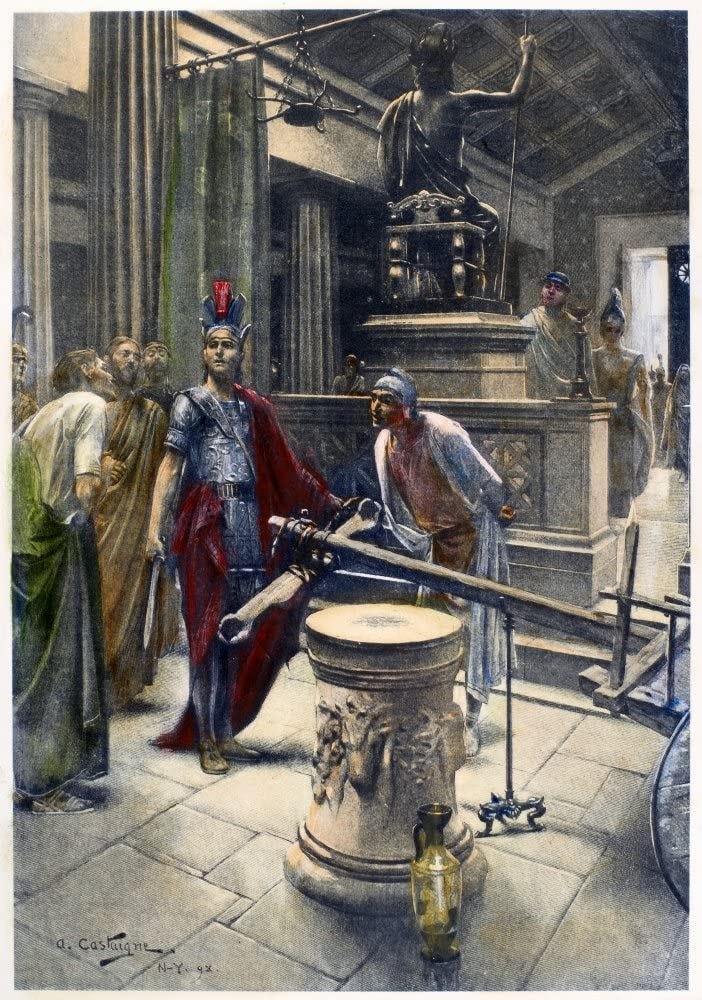
The story of the Gordian knot offers a powerful metaphor to how the interconnected global problems must be approached. No sword exists that can miraculously slice through them all or even one. Instead, we much do what Alexander the Great did, and analyze the system.
The eight interconnected problems
Today’s world confronts eight critical unsolved global problems:
Environmental sustainability (including climate change)
Backsliding from democracy to authoritarianism
High inequality of income and wealth
War
Endemic government corruption
Recurring large recessions and depressions
Systemic discrimination of many kinds
The power of large corporations
The first problem, if left unsolved will lead to global environmental collapse beginning sometime in the mid-21st century (Turner, 2012). The second problem, if left unsolved will lead to a world of authoritarian super-states in perpetual conflict, much like the dystopia described in George Orwell’s 1984 where Oceania, Eurasia, and Eastasia were perpetually at war. The third problem leads to a world controlled by the rich and powerful, the so-called 1%, who by nature care little about the other 99%. The fourth problem leads to death, destruction, and suffering by far too many, with the constant risk of catastrophe, such as by nuclear, germ, or robotic warfare. And so on. (More problems could be included, but for simplicity we stopped at eight.)
What makes this class of problems so insanely difficult to solve is their interconnections. Once environmental collapse begins, states are too weak to devote large resources to solving any other problems, and growing resource scarcity provokes conflict, which can lead to war. Authoritarians, the super rich (with rare exceptions), and corrupt politicians care only about themselves rather than the common good, and hence are adverse to solving the other problems. States at war or undergoing economic pain are unable to devote large resources to any other major problem. More authoritarianism increases corruption, since financial rewards are the main way autocrats reward and control their supporting economic elite. As the power of large corporations increases so does corruption, since that’s how corporations control governments. So does authoritarianism, since large corporations and their owners are the main powerbase of modern authoritarians.
Systemic discrimination is always the fallacy of painting a false enemy, for the purpose of an enticing pillar in an ideology. If the ideology is political, which it often is, attention on that false enemy draws attention away from problems that really matter, and falsely justifies giving more power to a strong leader (a rising authoritarian) who can solve the non-existent problem. An example is the way the far-right in Europe and the US claims immigrants are taking over, taking away jobs, and bringing in more crime and drugs (none of this is true). This Gordian knot of relationships is illustrated below.
The Gordian knot illustrated
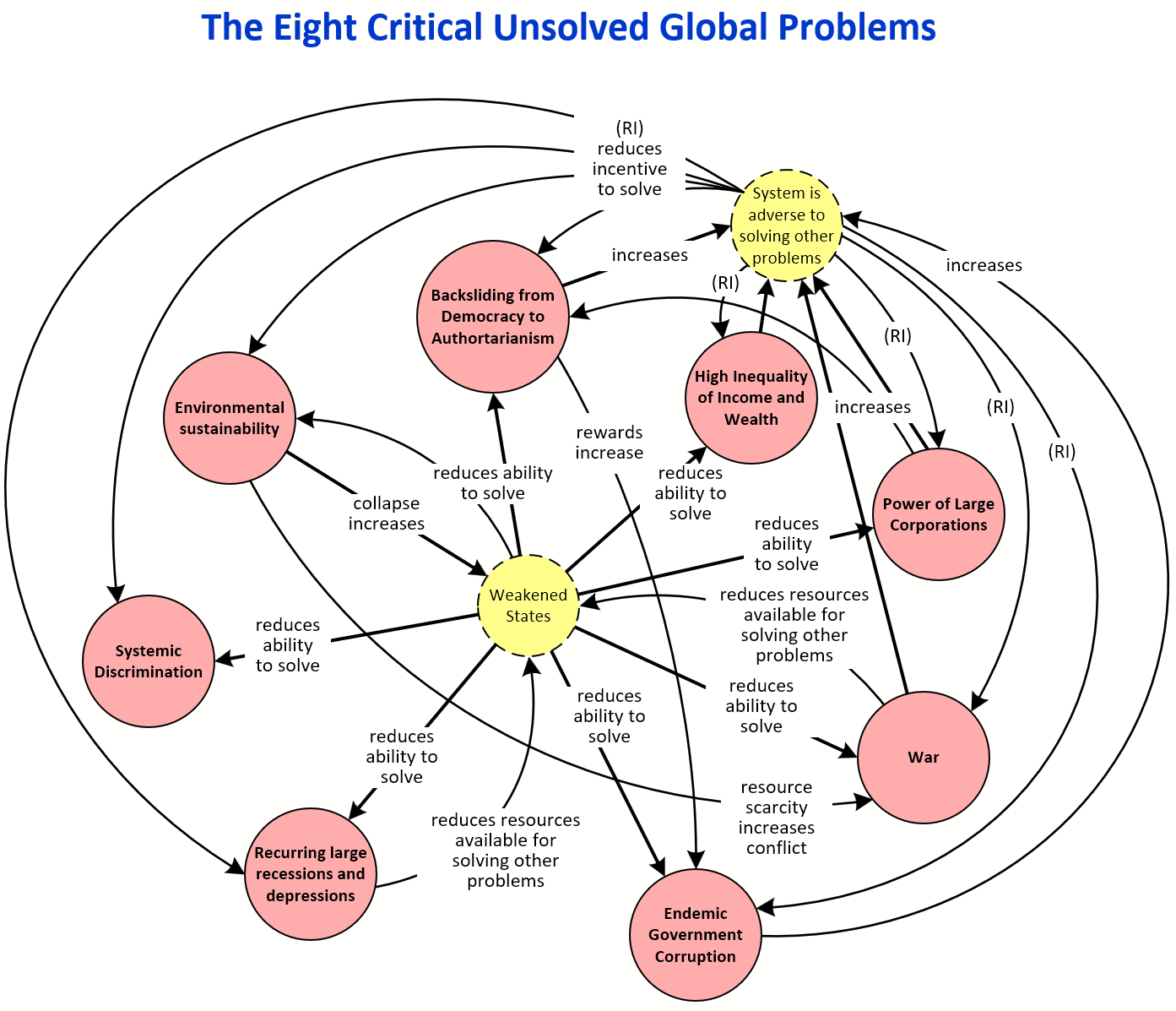
Like the mythical Gordian knot, there is no visible end. That and the birds nest of complex relationships make it terribly hard to determine how to solve the total problem. Worse yet, most problem solving efforts focus only on one problem at a time and ignore the others and their relationships. This dooms single problem solutions to inexplicable failure. That, unfortunately, is the present state of where most NGOs, academics, and governments are on solving these problems, despite what a quote related to The Predicament of Mankind urges below.
Note how the diagram contains many reinforcing feedback loops. For example, as the power of large corporations increases, so does system is adverse to solving other problems. That in turn increases the power of large corporations. But it also reduces incentive to solve the environmental sustainability problem, which increases weakened states, which reduces the ability to solve the power of large corporations problem. Inspection reveals the diagram contains many such feedback loops, each of which causes the system as a combined whole to strongly and cleverly resist solution.
This condition is known as systemic change resistance. This emergent property of the system, which is well hidden by complexity, is the central reason traditional solutions fail. Systemic change resistance and its role in the sustainability problem was examined in a 2010 Thwink.org paper: Change Resistance as the Crux of the Environmental Sustainability Problem.
Naming the problem
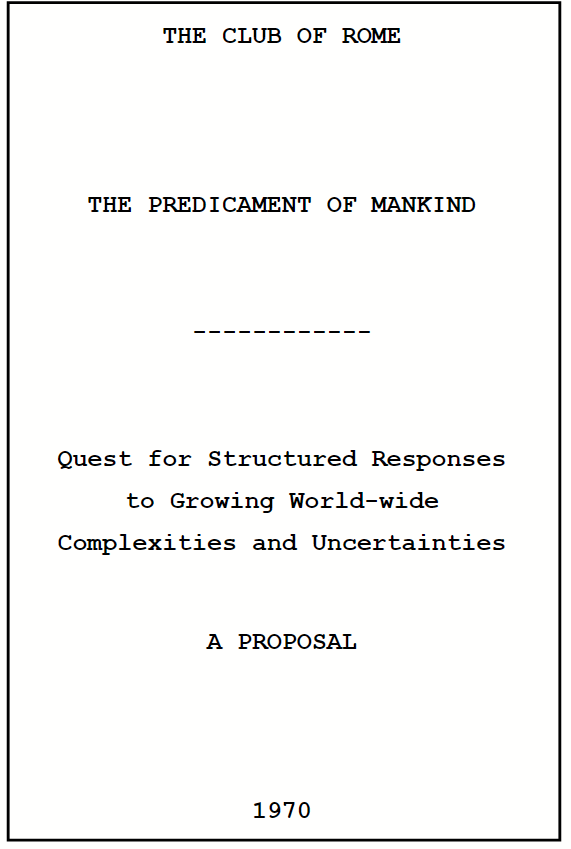
What would be a good name for this class of difficult large-scale social problems? Rather than call it Civilization’s Gordian Knot, we can turn to The Club of Rome, which identified and named the problem in 1970 as the global Problematique. The club commissioned The Predicament of Mankind, a 72-page foundational research proposal which named the problem:
The Predicament of Mankind …was put together under the towering leadership of [Prof] Hasan Ozbekhan, probably one of the best systems thinkers of the 20th century. It described very eloquently the predicament of mankind. It identified approximately 50 Continuous Critical Problems, which on account of their strong interactions should not be addressed in a piecemeal fashion. Such problems as the “pollution problem,” the “inner city problem,” the “poverty problem,” the “starvation problem,” the “nuclear proliferation problem,” the “population growth problem,” and so on, are strongly interconnected, contributing to the emergence of a new entity called in the proposal the global Problematique.
The concept and the name Problematique appeared for the first time in the Club of Rome proposal. The proposal recognized and described the futility of addressing these problems in a piecemeal fashion, instead of addressing them as a system of problems. It proceeded to conceptualize and articulate very elegantly a philosophical, methodological, and institutional framework for penetrating and resolving the global Problematique.
(The source for this quote, http://quergeist.net/Problematique_Club-of-Rome.htm, no longer exists. However, it continues to be an accurate description.)
Next article
This article described the problem to solve, its ultra-high complexity, the presence of systemic change resistance, and the futility of attempting to solve one problem at a time instead of addressing the system of problems as a whole.
The next article begins our analysis of the global Problematique by posing a question that will make all the difference: WHY have we been unable to solve the global Problematique since it was first identified in 1970?
References
Turner, G. M. (2012). On the Cusp of Global Collapse? Updated Comparison of The Limits to Growth with Historical Data. GAIA - Ecological Perspectives for Science and Society, 21(2), 116–124. https://doi.org/10.14512/gaia.21.2.10